At the West Valley Food Pantry, food rescue is about more than collecting extra groceries; it is about caring for our community. The Pantry partners with local grocery stores and food donors to rescue fresh produce, dairy, baked goods, and other nutritious items that might otherwise go to waste every weekday. Volunteer drivers pick up the groceries from our partner grocery stores and deliver them to the pantry, where our team of sorters carefully sorts the food, checking each item to make sure it is safe, fresh, and safe for individuals to enjoy. Good food is quickly packed and distributed to families in need, usually the same day. Items that do not pass the quality check get composted and picked up by the team at WM. In addition, the WM team picks up all our recyclables, including the boxes that the groceries arrive in.
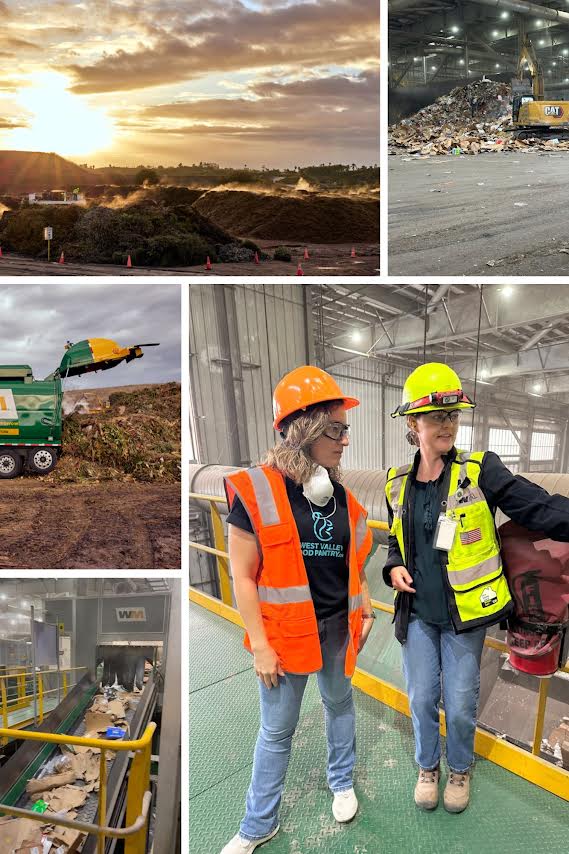
Recently, our team had the opportunity to tour the state-of-the-art WM recycling and organics facility in Sun Valley. The visit gave us a firsthand look at what happens after food and recyclables leave our Pantry’s bins. The facility itself is remarkable, built on what was once a former dump site, it has been transformed into a modern recycling park that now serves as a model for sustainability and innovation.
At the Pantry, not every rescued food item can be distributed. Some food arrives damaged, spoiled, or no longer of high enough quality to safely serve our clients. Instead of sending those items to a landfill, the Pantry places them into composting bins. WM then collects the organic waste and transports it to their Sun Valley organics processing facility, where advanced systems separate food scraps and convert them into useful products. The food waste is transformed into a nutrient-rich slurry that helps create renewable natural gas and fertilizer, turning what was once considered trash into a valuable resource for the environment.
During the tour, we also saw incredible technology at work on the recyclables side of the business. Optical sorters use infrared scanners and bursts of air to identify and separate recyclable materials, while AI-powered robots can sort up to 80 items per minute after they have passed through the line of human sorters. We watched as workers and machines worked side by side to recover cardboard, paper, metal, plastics, and glass as efficiently as possible. One of the most important lessons we learned was that recycling works better when the materials arriving at the facility are clean and properly sorted. The cleaner the incoming recyclables, the more material can successfully be recycled instead of ending up in a landfill.
For more information on the work that WM is doing, visit: www.wm.comceremony.

.png)